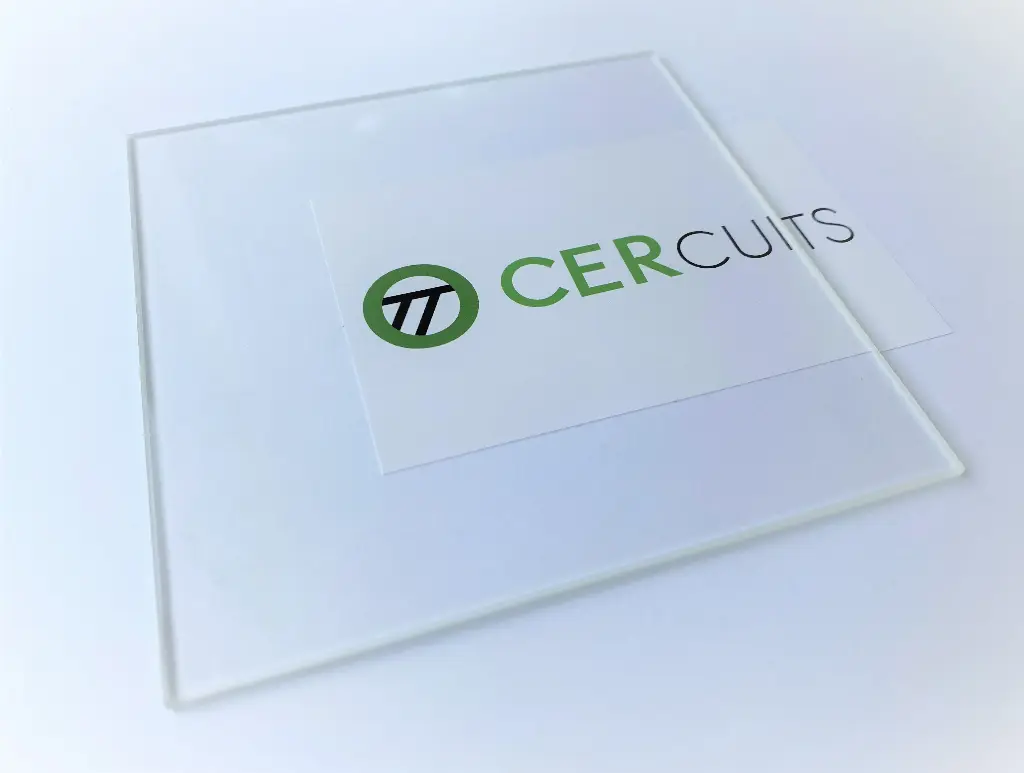
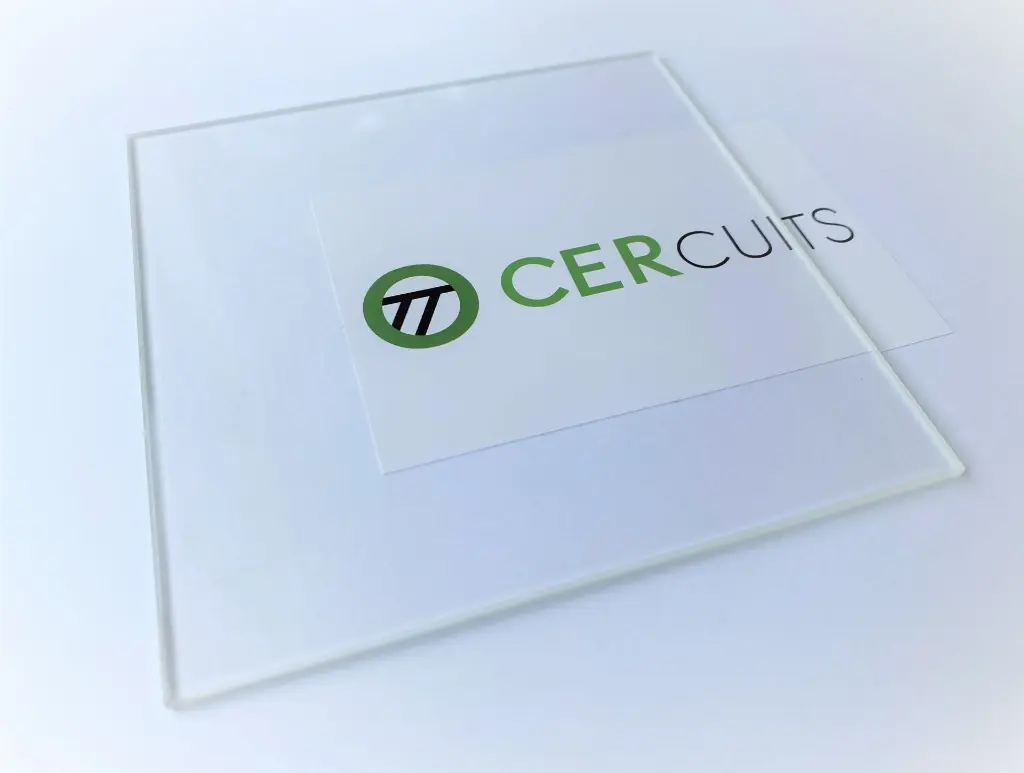


Borosilicate glass is chemically resistant, has a low thermal expansion coefficient, and can be used at relatively high temperatures.
Its main benefits are:
- very high chemical resistance
- high operating temperature
- Minimal thermal expansion (3.3 ppm/C)
- High thermal shock resistance
The typical composition contains SiO2 (approx. 80 %), 13 % B2O3 and others (Na2O / K2O, Al2O3)
Our Borosilicate substrates come in a 100 mm x 100 mm square format. We currently stock 2mm thick plates, but other thicknesses are available on request. Please get in touch with us.
Borosilicate properties
| Property | Items | Unit | SiO2 (approx. 80 %), B2O3 |
|---|---|---|---|
| Physical / Optical | Color | - | Transparent |
| Material - SiO2 | % | ~80% | |
| Water absorption | % | 0 | |
| Optical Transmission @ wavelength | - | >90% @ 310 tot 2200 nm | |
| Refractive Index | n | 1.47 | |
| Electrical | Dielectric Constant | e | 4.6 |
| Dielectric Loss | 3.7 | ||
| Dielectric strength | MV/m or KV/mm | 30 | |
| Mechanical | Density after Sintering (Bulk density) | g/cm3 | 2,23 |
| Flexural Strength (Bending) | Mpa | 120-160 | |
| Young’s Modulus | Gpa | ~63 | |
| Poissons ratio | 0.2 | ||
| Thermal | Coefficient of Thermal Expansion (CTE) | ppm/°C | ~3,3 |
| Transformation (Tg) | °C | 525 | |
| Thermal Conductivity (25°C) | W/m‧K | ~1.4 |
The
data shown is typical of commercially available material and is only
offered for comparative purposes. The information shall not be
interpreted as absolute material properties, nor does it constitute a
representation or warranty for which we assume legal liability. User
shall determine the suitability of the material for the intended use and
assumes all risk and liability whatsoever in connection therewith.